













1. Company Profile
General conditions, locations, business model, starting point.
Blog


DATE
30.6.2025
AUTHORS

Dr. Merlin C. Köhnke
TOPICS
Climate management
Best Practices
SHARE


Decarbonization is no longer just a nice-to-have; it is a business-critical necessity. Companies in Germany must systematically reduce their emissions and comply with regulatory obligations such as the CSRD or the CSDDD. With the BAFA Module 5 – Transformation Plans, the government supports companies in developing a strategically sound roadmap to climate neutrality – with funding covering up to 60% of the costs (max. €80,000).
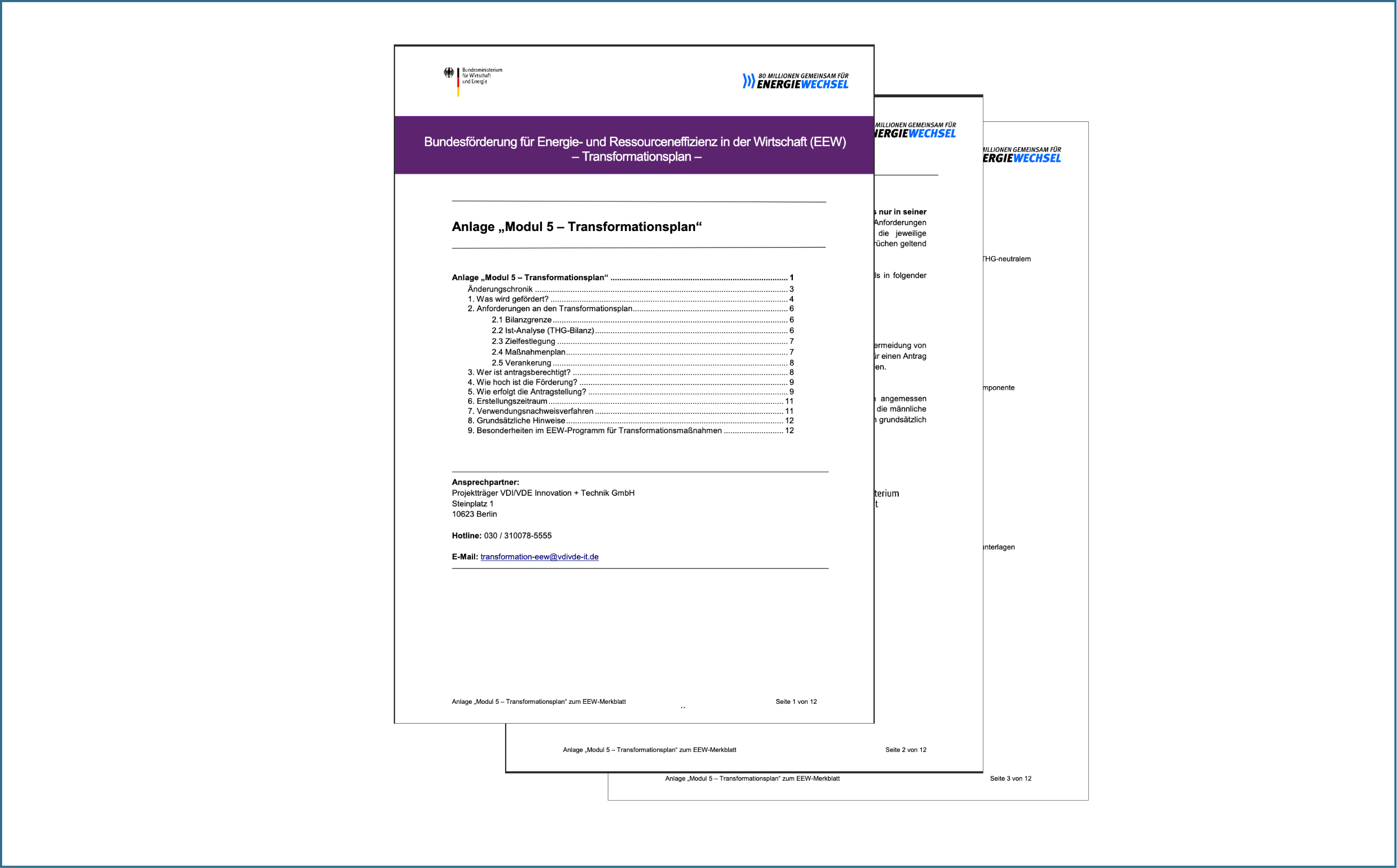
A climate transformation plan is not merely a set of calculations, but a strategic management tool. It outlines how a company can become climate-neutral step by step and identifies the measures required to achieve this.
Unlike a simple carbon footprint calculation or a sustainability report, the transformation plan outlines which levers to pull, when, and with what resources, showing how a company reduces emissions, plans investments, and prioritizes measures.
General conditions, locations, business model, starting point.
Reporting in accordance with the GHG Protocol, including Scopes 1–3.
Analyze emission drivers and identify reduction levers.
Present a decarbonization pathway, including climate neutrality by 2045.
Projects with timelines, costs, and reduction effects.
Clarify responsibilities and management involvement.
KPIs, progress reports, and a performance management system.
Final report with project documentation for funding.
According to BAFA Information Sheet 2024 (PDF download), a transformation plan must include at least the following elements:
The plan begins with a description of the company: its structure, business model, locations, and energy consumption. Important: It must be clear where the largest sources of emissions are.
No data, no strategy. Comprehensive reporting in accordance with the GHG Protocol is mandatory—including Scope 3 emissions (supply chain, business travel, purchased goods). The fact sheet emphasizes that indirect emissions must also be taken into account—an area where many companies have fallen short so far.
What measures has the company already implemented? Where does the greatest potential for efficiency gains and substitution lie? Baseline scenarios and existing programs are documented here.
A key component is the decarbonization pathway:
The centerpiece of the plan: a concrete list of measures, including:
The plan must outline how responsibilities are embedded within management. Without clear governance, well-intentioned plans risk remaining mere paper exercises that are never implemented. This is where ESG committees, CFO oversight, and supervisory board committees play a role.
Without measurable key performance indicators (KPIs), the plan will have no impact. Companies must demonstrate how they track progress—for example, through annual emissions reports, internal dashboards, or external audits.
The transformation plan is considered complete once comprehensive project documentation has been submitted. This documentation is subject to review and marks the conclusion of the funded project—which has a maximum duration of 12 months.
Not all components of a transformation plan carry the same weight. The BAFA clearly distinguishes between mandatory components, which are essential for eligibility, and optional elements, which can expand the plan and enhance its strategic value.
The following items must be included in the grant application and the final plan:
In addition, companies can enhance the plan with additional modules that, while not mandatory, are highly recommended:
Ensure eligibility and build strategic depth: on the left are the essential components; on the right are recommended areas for further development to establish thought leadership and ensure successful implementation.
GHG Footprint (Scopes 1–3)
Complete reporting in accordance with the GHG Protocol, including material categories in Scope 3.
Decarbonization pathway
At least a 40% reduction over 10 years (Scope 1 and 2) + a pathway to climate neutrality by 2045.
Action & Investment Plan
Specific projects with timelines, CAPEX/OPEX estimates, and expected emissions reductions.
Governance & Integration
Responsibilities, committees, and integration into strategy and operational processes.
Project Documentation
Complete final documentation – relevant for funding and auditing; project completion with handover.
In-depth scenario analyses
Alternative scenarios (energy prices, regulation, technology), including sensitivities.
Financial Planning
Multi-year planning with prioritization, capital commitment, and ROI/NPV analysis.
Risk and Opportunity Analysis
TCFD/ESRS-E1-compliant: Transition and physical risks, opportunities, and governance framework.
Stakeholder Engagement
Validation by customers, banks, and suppliers; eligibility for financing.
Communication Strategy
Internal/external communication, CSRD reporting, change enablement.
Note: Mandatory elements are relevant for funding and auditing purposes. Optional modules enhance the report’s informative value and interoperability (e.g., CSRD, financing), but are not required.
BAFA Module 5 – Transformation Plans is part of the federal funding program for energy and resource efficiency in the economy (EEW) and is implemented by the Project Management Agency Jülich (PtJ). The funding criteria are clearly defined and should be carefully considered:
Funding is provided exclusively for external consulting and analysis services, in particular:
The following, however, are not eligible for funding:
Applications for Module 5 must be submitted electronically via the BAFA portal. It is important to note that the application must be submitted before the project begins —retroactive funding is not permitted. The contracted consulting services may officially begin only after approval has been granted by the BAFA or the Project Management Agency Jülich (PtJ).
The reporting requirements are equally important. At the end of the project, a complete final report along with project documentation must be submitted. These documents are relevant for funding purposes and will be subject to random audits. If the requirements are not met or the documents are not submitted properly, the BAFA may demand the return of some or all of the funding.
GHG Footprint (Scopes 1–3)
Complete reporting in accordance with the GHG Protocol, including material categories in Scope 3.
Decarbonization pathway
At least a 40% reduction over 10 years (Scope 1 and 2) + a pathway to climate neutrality by 2045.
Action & Investment Plan
Specific projects with timelines, CAPEX/OPEX estimates, and expected emissions reductions.
Governance & Integration
Responsibilities, committees, and integration into strategy and operational processes.
Project Documentation
Complete final documentation – relevant for funding and auditing; project completion with handover.
In-depth scenario analyses
Alternative scenarios (energy prices, regulation, technology), including sensitivities.
Financial Planning
Multi-year planning with prioritization, capital commitment, and ROI/NPV analysis.
Risk and Opportunity Analysis
TCFD/ESRS-E1-compliant: Transition and physical risks, opportunities, and governance framework.
Stakeholder Engagement
Validation by customers, banks, and suppliers; eligibility for financing.
Communication Strategy
Internal/external communication, CSRD reporting, change enablement.
Note: Mandatory elements are relevant for funding and auditing purposes. Optional modules enhance the report’s informative value and interoperability (e.g., CSRD, financing), but are not required.
1. Clear objectives – binding and measurable
The BAFA requires a reduction of at least 40% over 10 years and a pathway to climate neutrality by 2045. By doing so, a company simultaneously meets the requirements of international standards such as the SBTi and regulatory frameworks such as the CSRD.
2. Strict time management
With a maximum project duration of 12 months and a requirement for project documentation, the program enforces clear timelines—an advantage for moving sustainability from the “nice-to-have” category into the core business.
3. Attractive grants
With funding of up to 60% —and up to €90,000 for SMEs—the BAFA significantly lowers the barrier to entry. This makes it possible to carry out high-quality analyses and implement strategies that would otherwise often be derailed by budget constraints.
4. Strategic planning instead of isolated actions
Funding is provided exclusively for planning, not for the implementation of individual measures. In this way, Module 5 prevents costly hasty decisions and lays the groundwork for investments that yield long-term results.
5. Regulatory Precautions
CSRD and CSDDD requirements explicitly call for climate transition plans. Those who act now are not only eligible for support but also gain early regulatory protection —a strong signal to investors, banks, and customers.
BAFA Module 5 is a real opportunity: With government funding, a scientifically sound climate transformation plan is developed that not only helps companies with their grant applications but also positions them strategically for the future.
If you’d like to determine whether your company is eligible for funding and how to develop a robust transformation plan, we’d be happy to assist you. Five Glaciers Consulting supports you every step of the way—from the application process to project documentation—with a practical, scientifically sound, and strategically aligned approach.

Climate management
Reporting
Governance & regulation

Best Practices
Governance & regulation

Governance & regulation
Climate management


Contact us for all concerns and questions relating to sustainability. We are happy to make time for a personal meeting or a digital coffee.
Headquarters in Hamburg
Tel.: +49 174 1305766
Email: info@fiveglaciers.com
Branch Office in Kiel
Tel.: +49 (0) 174 1305766
Direct appointment booking


