












DATE
4.6.2025
AUTHORS

Luka Marie Sauer
TOPICS
Ratings & certifications
Experiences & comments
SHARE


Blog


DATE
4.6.2025
AUTHORS
Luka Marie Sauer
TOPICS
Ratings & certifications
Experiences & comments
SHARE
EcoVadis has long since become more than just a niche tool for sustainability managers. With over 125,000 companies assessed worldwide and an increasingly prominent role in the procurement processes of large corporations, the platform serves as a gateway into global supply chains for many suppliers. But as its reach expands, so do the questions: Is it really worth the effort? What are the costs—both direct and indirect? And how robust is the methodology in light of growing regulatory requirements such as the CSRD or the planned CSDDD?
This article examines how EcoVadis works, its methodology, costs, criticisms, and alternatives in 2025—and shows how companies can use the tool strategically rather than being driven by scorecards.
At its core, EcoVadis evaluates companies’ sustainability performance based on four key areas: Environment, Labor & Human Rights, Ethics, and Sustainable Procurement. The methodology follows a three-tiered framework: Policies (statements of intent and guidelines), Actions (concrete measures, management systems, processes), and Results (outcomes and key performance indicators). This process is supplemented by the so-called 360° Watch, a media and stakeholder analysis that incorporates both positive and negative public reports into the assessment.
The result is a scorecard with scores ranging from 0 to 100, supplemented by industry benchmark data and specific recommendations for improvement. Companies that perform particularly well receive medals—ranging from bronze to platinum—which are increasingly becoming a key to success in B2B business.
It is important to note the distinction here: EcoVadis does not directly measure emissions or impact metrics. Rather, it is a document- and evidence-based assessment that evaluates how systematically sustainability is integrated into strategy, structures, and processes.
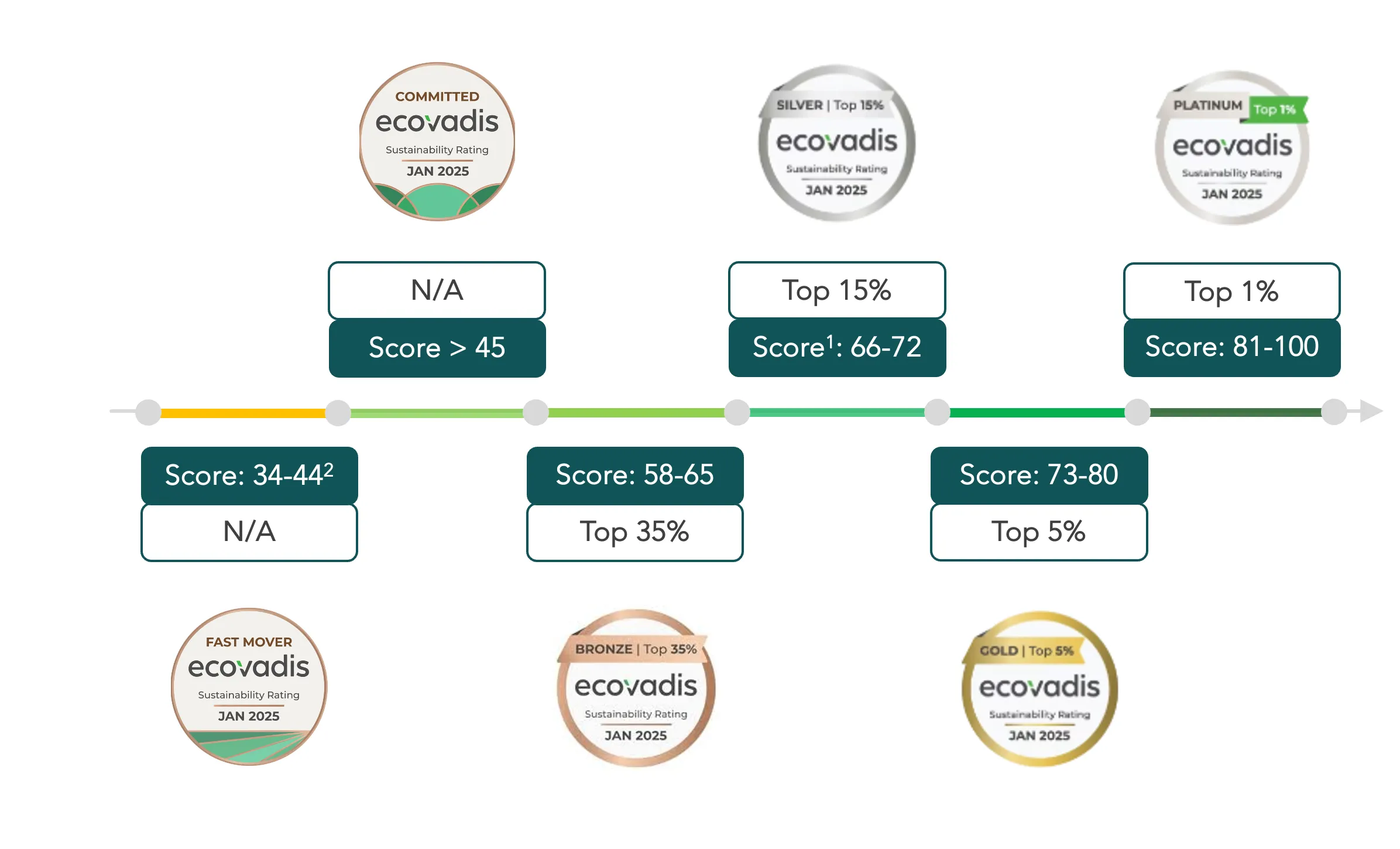
EcoVadis’ methodology is regularly updated—and has been significantly tightened since 2025. Scores are now displayed without rounding, making even minor improvements visible. For many companies, this is an opportunity to demonstrate progress that was previously lost in the average figures.
Another change concerns the awarding of medals: whereas platinum medals used to be handed out indiscriminately, they are now awarded only to the top 1% of all evaluated companies. This increases their exclusivity—but also the pressure to consistently deliver results.
The document requirements have also become more specific: a maximum of 55 supporting documents may be submitted, and these must be clearly dated, versioned, and formally correct. A PDF without clear authorization may already be deemed “unreliable.” At the same time, the role of 360° Watch is becoming more significant: negative press reports or criticism from NGOs can have an immediate impact on the score.
One critical issue remains: The methodology primarily assesses whether guidelines and processes are in place—not necessarily whether they are effectively implemented. For companies, this means that those who excel at documentation can score points relatively quickly; actual impact data plays a secondary role.
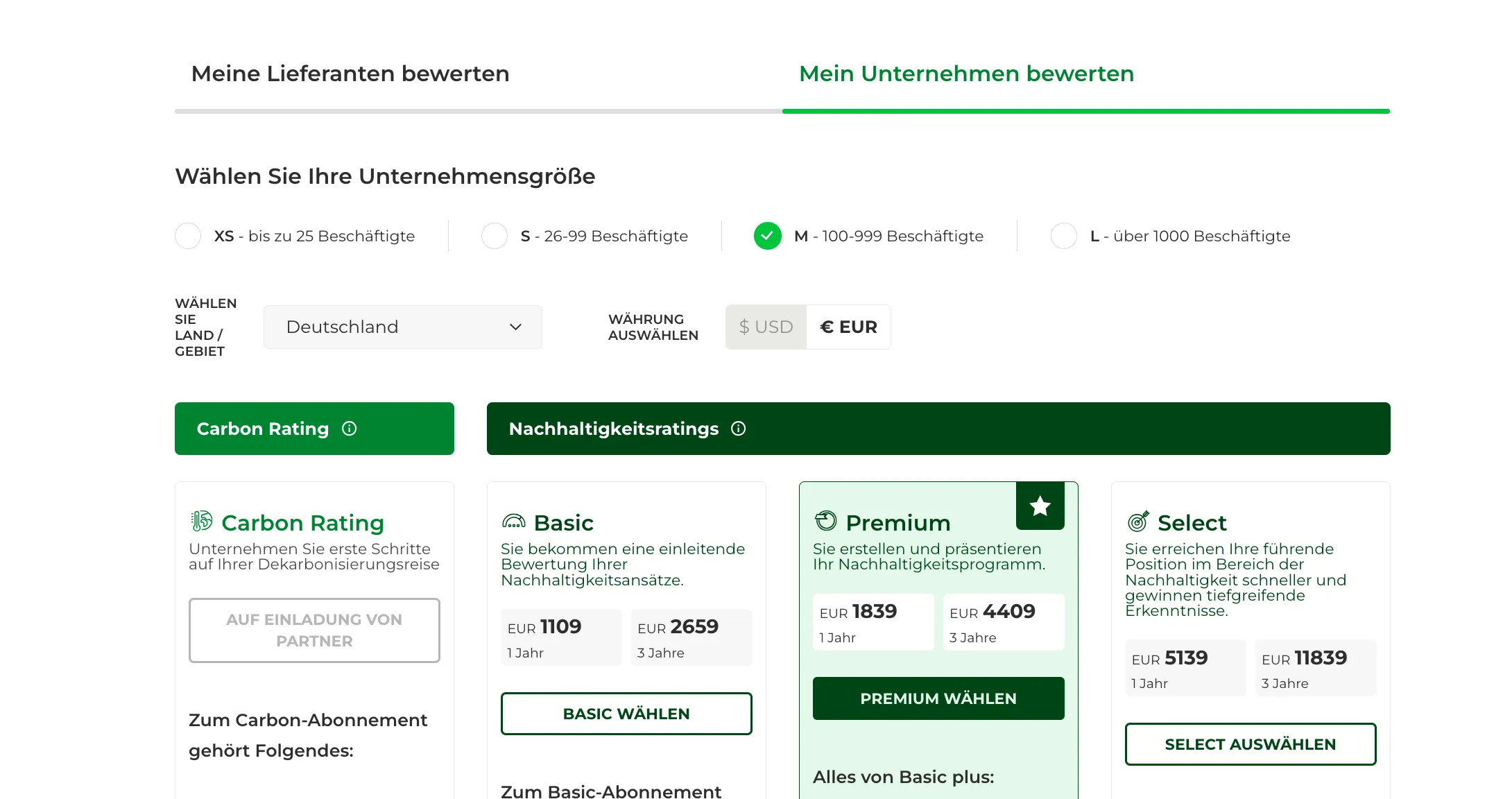
List prices vary depending on company size, country/currency region, and license term. On its official pricing page , EcoVadis currently lists the following approximate prices for Germany, size category M (100–999 employees) (as of today):
The Carbon Rating (Climate Scope only) is available only by invitation from a business partner; the Carbon Rating is also included in the Sustainability Ratings. Prices and features also vary by plan (e.g., sharing options, analyst sessions, monitoring). Therefore, always check the local pricing page and select EUR/USD as well as XS/S/M/L to see the amounts relevant to you.
However, the real effort lies within the companies themselves: Sustainability and compliance departments report that first-time participants among SMEs spend between 50 and 150 hours on the process. In corporations with a decentralized structure, this can easily exceed 300 hours —spread across sustainability, HR, environmental, and procurement teams. In addition, there may be consulting costs if internal expertise is lacking.
This makes it clear: EcoVadis is not just a simple questionnaire, but a project that involves internal resource costs. Many companies underestimate this aspect and view the subscription fee as the main cost—but in reality, the effort lies in data collection, coordination, and documentation.
EcoVadis divides opinion. On review sites like G2, the platform averages 3.8 out of 5 stars—a solid score, but with significant variation both above and below that average. Its clear structure is praised: companies receive not just a grade, but a comparable scorecard and benchmarks that are widely accepted in the market. For buyers, EcoVadis is a quick way to systematically rank suppliers.
The criticism focuses primarily on three points:
Another point of criticism is the dependency: Once you’re part of the network, you’ll find it hard to avoid providing annual updates. This creates a lock-in effect, which primarily entails costs for suppliers but offers buyers certain standardization benefits.
EcoVadis is not the only platform for sustainability assessments. However, the alternatives each have different areas of focus.
CDP, for example, places a strong emphasis on climate and environmental risks and is primarily aimed at capital markets. Sustainalytics is similarly investor-driven and assesses ESG risks at the corporate level, not at the supplier level. CSRHub aggregates data from many sources but does not delve as deeply into the processes of individual companies.
Certifications like B Corp are quite different; they comprehensively assess sustainability—from governance to employee well-being—but require a rigorous audit. Product certifications such as FSC, Fairtrade, or Rainforest Alliance, on the other hand, focus on specific raw materials or segments of the supply chain and are better suited for product-level claims than for an overall assessment.
In contrast, EcoVadis primarily offers supply chain compatibility: large buyers use it as a standard to compare hundreds or thousands of suppliers. Alternative systems can supplement this, but rarely replace it.
In 2025, EcoVadis will remain a key component for companies seeking to participate in global supply chains. However, it is crucial to view the platform strategically: not merely as a certificate, but as a tool that integrates reputation, customer requirements, and internal management.
Those who underestimate the process risk incurring high opportunity costs and frustration. However, those who implement it professionally can use EcoVadis to systematically embed sustainability within their organization, win over stakeholders, and gain a competitive edge.
Five Glaciers Consulting helps companies navigate this process in a structured manner—from preparing the initial scorecard and refining the methodology to integrating it into a comprehensive sustainability strategy.

Experiences & comments

Governance & regulation
Ratings & certifications
Climate management

Ratings & certifications
Strategy


Contact us for all concerns and questions relating to sustainability. We are happy to make time for a personal meeting or a digital coffee.
Headquarters in Hamburg
Tel.: +49 174 1305766
Email: info@fiveglaciers.com
Branch Office in Kiel
Tel.: +49 (0) 174 1305766
Direct appointment booking


