










Blog

Climate Protection with a Cost-Benefit Analysis: MACC Analyses as a Planning Tool for Decarbonization Strategies

Orange downward arrow to the content

DATE

14.7.2025

AUTHORS

Dr. Merlin C. Köhnke

Dr. Merlin C. Köhnke

TOPICS

Best Practices

Climate management

SHARE

What is a MACC analysis?

The Marginal Abatement Cost Curve (MACC) is an analytical tool that helps companies systematically evaluate emission reduction measures. It graphically illustrates the cost per ton of CO₂e avoided in relation to the potential savings, thereby enabling data-driven prioritization of measures.

In a MACC, measures are visualized along two axes:

  • X-axis: Potential savings in tons of CO₂e per year
  • Y-axis: Marginal cost in euros per ton of CO₂e avoided

Negative values on the Y-axis indicate measures that are economically beneficial (e.g., energy efficiency), while positive values represent investments that incur costs.
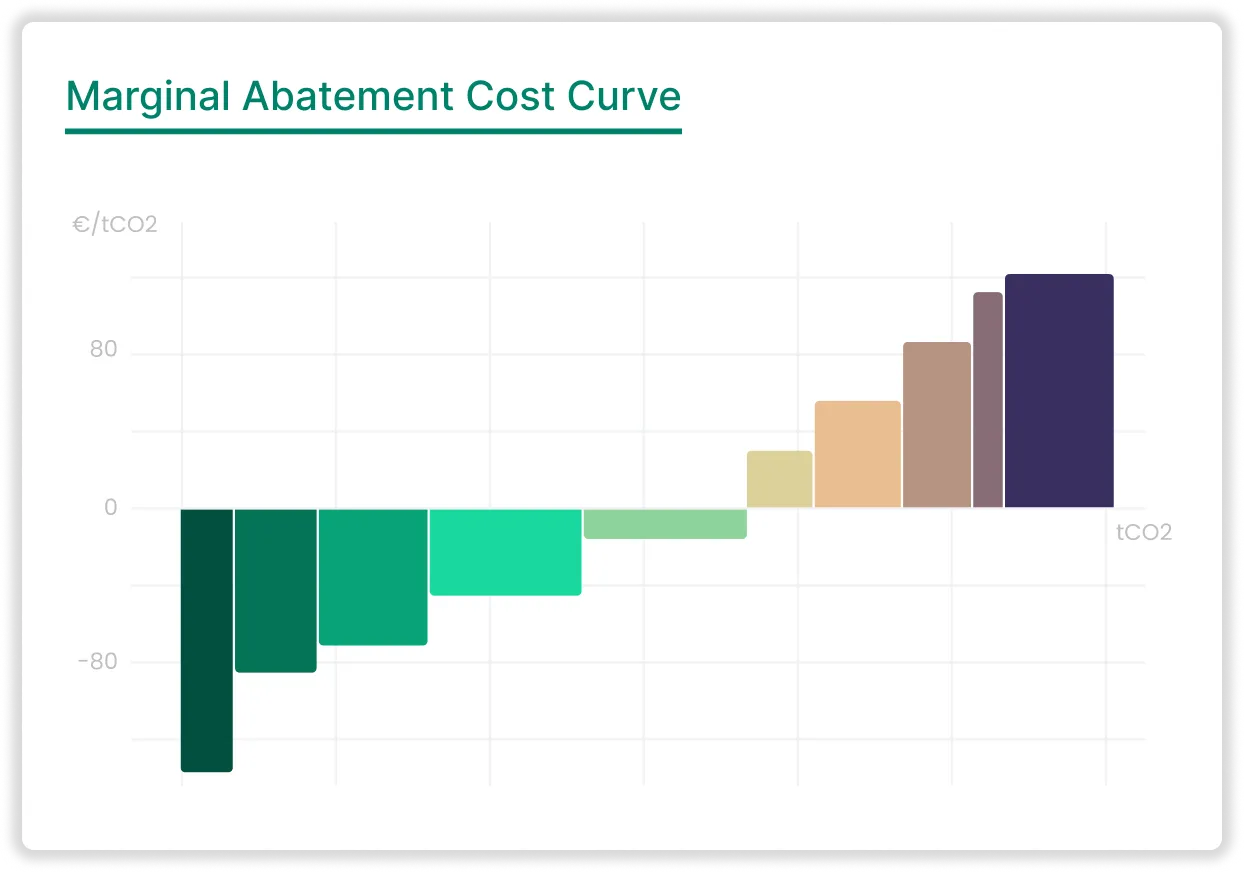
Source: Tennaxia.com (https://www.tennaxia.com/en/blog/plan-action-carbone-et-macc)

Why MACC Analyses Are Critical for Businesses

For companies seeking to reduce their carbon footprint in a sustainable yet economically viable manner, MACC analyses serve as a key management tool. They provide a data-driven overview of which emission reduction measures are associated with what costs—thereby enabling precise planning of decarbonization measures based on economic and strategic criteria.

Key benefits of a MACC:

  • a clear prioritization of measures based on cost-effectiveness and potential savings;
  • the development of realistic emission reduction pathways, e.g., by 2030 or 2045;
  • a targeted allocation of capital expenditure and ESG budgets to effective measures;
  • clear and fact-based communication with management, the supervisory board, and investors;
  • the integration of policy packages into regulatory frameworks such as the CSRD, SBTi roadmaps, or climate transition plans.

MACCs are therefore not just a tool for the sustainability department, but a valuable component of strategic and financial corporate planning. They serve as a bridge between climate goals and investment decisions—and strengthen companies’ ability to transform themselves credibly and effectively.

In a nutshell: How the MACC design works

Marginal costs (€/t CO₂e) are calculated for each measure. In other words:

Marginal cost = (CAPEX + OPEX − savings − subsidies) / total CO₂e avoidance

Based on this logic, it typically requires the following data points for each measure:

  • CO₂e savings (per year and over the product's lifetime)
  • CAPEX/OPEX, residual values, service life, commissioning
  • Energy and commodity prices, subsidy framework, discount rate
  • Maturity & Dependencies (e.g., infrastructure)

The dynamic nature of MACC results

A MACC is not a static tool. It is based on assumptions that change over time:

  • Technological developments: e.g., falling costs for solar power, battery storage, or green hydrogen
  • Changes in the regulatory environment: CO₂ prices, subsidies, legal obligations
  • Inflation and Energy Price Volatility
  • Supply Chain Availability and Market Trends

The sequence of measures, their feasibility, and their cost-effectiveness are closely linked to dynamic external factors. Some measures must be implemented in combination, while others only take full effect later on. It is essential that these path dependencies be taken into account in the strategic analysis.

Best Practice: Update at least annually as part of climate strategy and budget planning, including sensitivity analyses (e.g., electricity prices, CO₂ prices) and scenarios (“Low Regret,” “Cost-Effectiveness,” “Technology-Driven”).

The Process: 6 Steps to a Resilient MACC

Developing a MACC requires interdisciplinary collaboration and structured project work. The following steps have proven effective in practice:

1. Project Launch and Goal Definition

  • Clarification of the scope (e.g., scope of application, consideration of Scope 1, 2, and 3)
  • Set target horizons (e.g., by 2030, 2040, 2050)
  • Involve stakeholders: Sustainability, Technology, Controlling, Procurement, and external partners as needed

2. Identification of measures

  • Bottom-up approach through workshops with departments
  • Supplemented by top-down benchmarking (e.g., industry standards, technology roadmaps)
  • Documentation of each measure, including savings potential, CAPEX/OPEX, lifespan, and readiness for implementation

3. Data modeling and calculation of marginal costs

  • Calculation of CO₂e reduction over the product's lifespan (e.g., t CO₂e/10 years)
  • Calculation of the net present value of costs (including discounting and subsidies)
  • Calculation of specific costs in euros per ton of CO₂e

Formula:
Marginal cost = (Investment costs + Operating costs ± Savings ± Subsidies) / Total CO₂e avoided

4. Validation, Scenario Development, and Interdependencies

  • Sensitivity analyses (e.g., electricity price trends, CO₂ price, cost of capital)
  • Development of scenarios: "Low Regret," "Technology-Driven," "Cost-Effectiveness Focus"
  • Combinatorial analysis: Which measures are mutually dependent? Which ones lose their effectiveness if others are not implemented first?
  • Timeline: Some measures only take effect over the long term—for example, investments in infrastructure or changes to supply chains.

5. Visualization and Prioritization

  • Representation in a MACC graph (see below)
  • Sorting by ascending marginal costs
  • Categorization (e.g., can be implemented immediately, economically viable in the medium term, strategically necessary)

6. Integration into Strategy and Budget

  • Integration into climate target frameworks (e.g., SBTi, internal reduction pathways)
  • Deriving investment proposals for the sustainability budget and CapEx planning
  • Inclusion in the CSRD-compliant climate transition plan
  • Development of business cases to support decision-making (including payback, ROI, and risks)

From Analysis to Strategy: What's Next?

A MACC is not an end in itself. It truly comes into its own when it is systematically integrated into strategic decision-making:

  • Which measures contribute significantly to achieving the goals?
  • Where are the "low-hanging fruits" that can be implemented immediately?
  • Which investments require strategic upfront costs despite positive marginal costs?
  • What measures are required for partnership-based implementation models (e.g., PPAs, joint ventures)?
  • How can measures be combined in a logical and efficient way?
  • Which business cases are convincing enough to win over the finance department?

Companies should therefore not treat MACC analyses as a technical tool confined to the sustainability team, but rather view them as a central component of ESG investment and transformation management.

Conclusion: MACC analyses as a driving force for effective climate strategies

Marginal abatement cost curves provide companies with a clear, data-driven view of their climate pathway: Which measures reduce CO₂e emissions by how much—and what do they actually cost? This is not just a matter of cost-effectiveness, but also of strategy, credibility, and risk management.

In an era of rising expectations driven by the CSRD, climate targets, and capital markets, the ability to manage transformation efficiently and effectively is becoming a competitive advantage. A MACC is an indispensable foundation for this—if it is done right.

Would you like to develop your own MACC analysis or elevate your existing one to a strategic level?
We’ll support you every step of the way, from data collection to implementation.

Author: Five Glaciers Consulting – Strategy. Impact. Climate.

Conclusion: MACC analyses as a driving force for effective climate strategies

Marginal abatement cost curves provide companies with a clear, data-driven view of their climate pathway: Which measures reduce CO₂e emissions by how much—and what do they actually cost? This is not just a matter of cost-effectiveness, but also of strategy, credibility, and risk management.

In an era of rising expectations driven by the CSRD, climate targets, and capital markets, the ability to manage transformation efficiently and effectively is becoming a competitive advantage. A MACC is an indispensable foundation for this—if it is done right.

Would you like to develop your own MACC analysis or elevate your existing one to a strategic level?
We’ll support you every step of the way, from data collection to implementation

Sources:
  1. UK Committee on Climate Change (CCC): “The Macroeconomic Impact of Climate Change Mitigation Policies”; Link:https://www.theccc.org.uk/‍
  2. IPCC Fifth Assessment Report (AR5), Working Group III: Chapter 6.9.1: Marginal Abatement Cost Curves and MitigationPotential‍
  3. OECD (2015): “Marginal Abatement Cost Curves: A Call for Caution”;https://www.oecd.org/environment/tools-evaluation/MACC-Call-for-Caution.pdf‍
  4. Quantis (2021): “Accounting for Natural Climate Solutions Guidance”; https://quantis.com‍
  5. SBTi Guidance for the FLAG Sector (2023); https://sciencebasedtargets.org/sectors/forest-land-and-agriculture

Contact authors

Mountain in the background - symbolic image by Five Glaciers Consulting for contact page

We look forward to getting to know you!

Hike up a mountain - symbol image from Five Glaciers Consulting for contact page

Contact us for all concerns and questions relating to sustainability. We are happy to make time for a personal meeting or a digital coffee.

Headquarters in Hamburg
Tel.: +49 174 1305766
Email: info@fiveglaciers.com

Branch Office in Kiel
Tel.: +49 (0) 174 1305766

OR INQUIRE DIRECTLY ONLINE:

Thank you! Your submission has been received!
Oops! Something went wrong while submitting the form.