Blog

Guidelines for the EcoVadis Rating: How to Set Up Policies Correctly

Orange downward arrow to the content

DATE

28.8.2025

AUTHORS

TOPICS

Experiences & comments

Ratings & certifications

SHARE

For many companies, developing policies is the first major hurdle in the EcoVadis rating process. This is because policies are much more than just a piece of paper: they form the foundation of sustainability management and play a decisive role in determining whether your responses to the questionnaire are deemed valid.

This article explains how to develop, draft, and document policies so that they meet EcoVadis requirements—while also serving as effective management tools.

Why Policies Are So Important in the EcoVadis Rating

EcoVadis evaluates your sustainability management across three pillars: Policies, Actions, and Results.

  • Policies serve as the formal foundation—written commitments, goals, and principles.
  • They set the direction for which measures should be implemented.
  • Without sound policies, measures and KPIs cannot be placed in the proper context.

In short: Without policies, there can be no robust sustainability management.
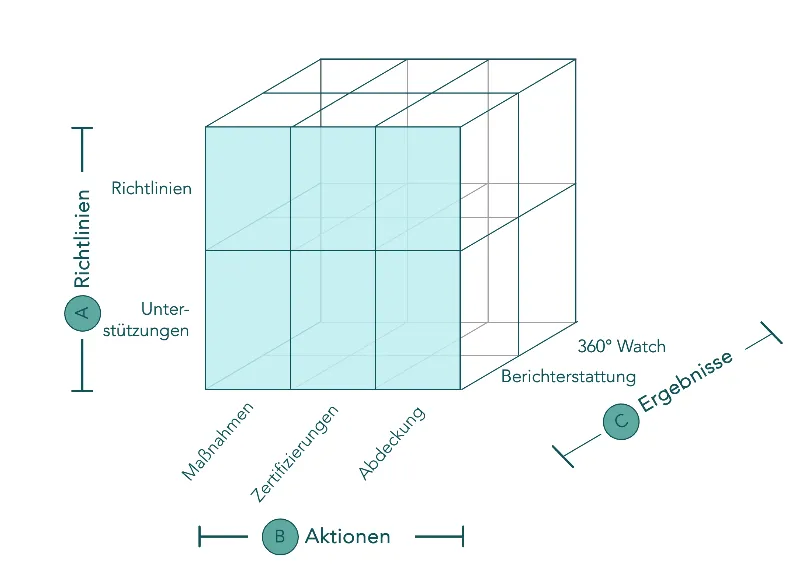
The Three Sustainability Criteria with Management Indicators: Actions, Guidelines, Results

Requirements for policies in the context of EcoVadis

For policies to be recognized by EcoVadis, they must meet certain criteria:

  1. Formally documented
    • In writing, dated and bearing the company name/logo.
    • No mere statements of intent in presentations or internal emails.
  2. Validity period
    • Policies are valid for up to 8 years.
    • They must have been officially approved before submission (at least one month prior to submission).
  3. Relevance & Scope
    • Must cover the entire scope of the assessment (not just one subsidiary or location).
    • Policies nur für einzelne Einheiten werden nicht berücksichtigt, wenn sie <80 % der Aktivitäten abdecken.
  4. Substantive content
    • Clear goals and commitments, ideally accompanied by measurable KPIs and deadlines.
    • Reference to international standards (ILO, UNGC, OECD, ISO standards) enhances credibility.

What policies do companies need?

Experience shows that companies with good EcoVadis scores have a set of core policies that cover all relevant areas.

Environment

  • Environmental policy
  • Energy and Climate Strategy
  • Waste and Circular Economy Policy

Labor & Human Rights

  • Code of Conduct (Employees)
  • Diversity and Inclusion Policy
  • Health & Safety in the Workplace

Ethics

  • Anti-Corruption and Anti-Bribery Policy
  • Whistleblower and Reporting System
  • Data Protection and Information Security

Sustainable Procurement

  • Supplier Code of Conduct (considered a separate “measure,” but closely related)
  • Responsible Sourcing Policy

EcoVadis Topics and Typical Policies

Subject area Typical Policies
Environment
  • Environmental policy
  • Energy and Climate Strategy
  • Waste and Circular Economy Policy
Labor & Human Rights
  • Code of Conduct (Employees)
  • Diversity and Inclusion Policy
  • Health & Safety in the Workplace
Ethics
  • Anti-Corruption & Anti-Bribery Policy
  • Whistleblower System
  • Data Protection & Information Security
Sustainable Procurement
  • Supplier Code of Conduct
  • Responsible Sourcing Policy

How to Set Up a Policy Correctly

An EcoVadis-compliant policy should not only include a statement of intent but also have a clear structure:

  1. Introduction & Scope
    • Who is this intended for (all employees, suppliers, locations)?
  2. Commitment & Principles
    • Reference to relevant standards (e.g., UNGC, ILO, ISO 14001).
  3. Goals & Key Performance Indicators
    • Specific quantitative targets: “We will reduce our CO₂ emissions by 30% by 2030 compared to 2020.”
  4. Governance & Responsibilities
    • Who is responsible (e.g., Sustainability Manager, Board Member)?
  5. Review & Update
    • How is the policy reviewed and updated?

Common Mistakes in Policies

  • Only minimum legal standards: Merely quoting laws or regulatory requirements does not constitute a valid policy.
  • No company reference: Documents without a company name or logo will be rejected.
  • Too generic: Copying and pasting from online templates without adapting them to your own business.
  • No longer valid: Policies older than 8 years are invalid.

Best Practices and Lessons Learned from Project Experience

A well-designed policy is much more than just a document for the EcoVadis rating. It reflects governance, values, and strategic direction —and at the same time serves as the foundation for robust sustainability management. Companies that systematically develop their policies reap dual benefits: they improve their rating scores while simultaneously establishing structures that also meet regulatory requirements such as the CSRD or the LkSG.

Based on our project experience, several best practices have proven effective:

  • Create a document library – centrally collect and version policies, and assign clear responsibilities.
  • Choose your language carefully – German is acceptable, but English enhances international readability and acceptance.
  • Leverage synergies – don’t develop guidelines for EcoVadis in isolation; instead, draft them in such a way that they can also be used in audits, reporting, or supply chain assessments.
  • Iterative development – even small businesses can start with streamlined policies and continue to refine them over the years.

As an official EcoVadis Consulting Partner, Five Glaciers Consulting helps companies develop policies that are legally sound, strategically sound, and operationally effective —thereby bridging the gap between achieving a high rating and genuine sustainability management.

FAQ on Guidelines in the EcoVadis Rating

Q: How many policies should my company have?

A: As many as are needed to cover all relevant topics—usually 5–10.

Q: Do policies have to be public?

A: No, they can remain internal, but they should be formally approved and documented.

Q: How detailed do policies need to be?

A: They should include qualitative commitments—ideally supplemented by quantitative goals.

Q: Can I use templates?

A: Yes, but only as a starting point. Every policy must be tailored specifically to your company.

Contact authors

Mountain in the background - symbolic image by Five Glaciers Consulting for contact page

We look forward to getting to know you!

Hike up a mountain - symbol image from Five Glaciers Consulting for contact page

Contact us for all concerns and questions relating to sustainability. We are happy to make time for a personal meeting or a digital coffee.

Headquarters in Hamburg
Tel.: +49 174 1305766
Email: info@fiveglaciers.com

Branch Office in Kiel
Tel.: +49 (0) 174 1305766

OR INQUIRE DIRECTLY ONLINE:

Thank you! Your submission has been received!
Oops! Something went wrong while submitting the form.