Introduction
A carbon footprint —often referred to as a corporate carbon footprint (CCF) —is the key tool for systematically tracking and reporting a company’s greenhouse gas emissions. It is far more than just a simple inventory: it serves as the foundation for climate strategies, investment decisions, and, increasingly, for meeting regulatory obligations.
Companies that understand their carbon footprint can pinpoint the sources of their emissions, prioritize actions, and transparently communicate their progress. As a result, the CCF is increasingly evolving from a voluntary sustainability tool into a mandatory component of modern corporate governance.
The goal is clear: to ensure transparency, identify opportunities for reduction, and effectively manage climate protection measures.
Preparing a carbon footprint analysis
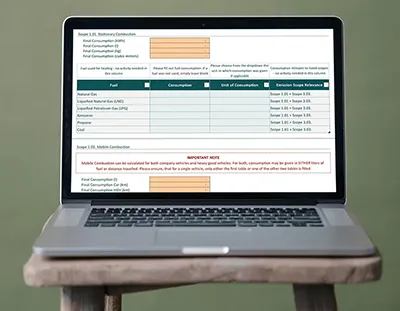
A robust carbon footprint assessment is based on established international standards such as the GHG Protocol or ISO 14064. It is divided into three scopes, which together cover the entire carbon footprint:
- Scope 1 (direct emissions): emissions generated directly by the company, e.g., from its vehicle fleet, heating systems, emergency generators, or industrial processes.
- Scope 2 (indirect emissions from energy): result from the purchase of electricity, heat, or cooling—a distinction is made here between site-based and market-based calculation methods.
- Scope 3 (indirect emissions from the value chain): covers the entire supply and use chain, e.g., emissions from suppliers, business travel, or the use of sold products by customers.
The carbon footprint thus accounts for all relevant greenhouse gases (CO₂, methane, nitrous oxide, etc.) in terms of CO₂ equivalents (CO₂e). In particular, there is a growing call to include Scope 3 emissions, as this category accounts for over 70% of total emissions in many industries.
GHG Protocol – Scopes & Categories
Overview of the emission scopes (Scope 1–3) and the associated categories.
Table with three columns: Scope, Title, Description.
| Scope |
Title |
Description |
| S1 Scope 1 |
Stationary combustion |
Direct emissions from stationary equipment such as boilers, furnaces, or generators. |
| S1 Scope 1 |
Mobile incineration |
Direct emissions from company-owned vehicles or machinery equipped with internal combustion engines. |
| S1 Scope 1 |
Process & fugitive emissions |
Emissions from processes (e.g., chemical reactions) and leaks (e.g., refrigerants). |
| S2 Scope 2 |
Purchased electricity |
Indirect emissions from electricity procurement – accounted for on a site-by-site or market-based basis. |
| S2 Scope 2 |
Purchased district heating and long-distance heating |
Emissions from the provision and use of purchased thermal energy. |
| S2 Scope 2 |
Purchased cooling |
Emissions from purchased cooling services (e.g., district cooling networks). |
| S3 Scope 3 |
3.1 Purchased Goods and Services |
Upstream emissions from the production or cultivation of purchased goods and services. |
| S3 Scope 3 |
3.2 Capital Goods |
Manufacture of durable capital goods (e.g., machinery, building fixtures). |
| S3 Scope 3 |
3.3 Fuel and Energy-Related Activities |
Upstream emissions from fuels/energy that are not included in Scope 1 or 2 (WTT shares, losses). |
| S3 Scope 3 |
3.4 Upstream Transportation & Distribution |
Transportation/distribution of purchased goods between suppliers and the company (including third-party logistics). |
| S3 Scope 3 |
3.5 Waste from business operations |
Treatment/disposal of waste generated by the company itself (not used in production at the customer's site). |
| S3 Scope 3 |
3.6 Business Travel |
Employee travel (air, rail, car, hotel – unless already included in Scope 1). |
| S3 Scope 3 |
3.7 Employee Shuttle Service |
Employees' commutes, including consumption related to working from home, where applicable. |
| S3 Scope 3 |
3.8 Assets Leased to Upstream |
Emissions from assets that the company leases or controls but does not report under Scope 1/2. |
| S3 Scope 3 |
3.9 Downstream Transportation & Distribution |
Transportation/distribution of sold products to retailers/customers (including storage) following shipment from the factory. |
| S3 Scope 3 |
3.10 Further processing of sold products |
Emissions generated when customers process the products further (e.g., intermediate products). |
| S3 Scope 3 |
3.11 Use of Sold Products |
Operational phase at the customer's site (e.g., energy consumption of a device, fuel consumption of vehicles). |
| S3 Scope 3 |
3.12 End-of-Life Products |
Disposal, recycling, or landfilling of the sold products after their useful life. |
| S3 Scope 3 |
3.13 Assets Leased Downstream |
Emissions from assets that the company leases to third parties (use by the lessee). |
| S3 Scope 3 |
3.14 Franchises |
Emissions from franchise operations not included elsewhere (units operated but not owned). |
| S3 Scope 3 |
3.15 Investments |
Proportionally allocated emissions from investments, portfolios, and financing in accordance with the GHG Protocol methodology. |
Why is a carbon footprint important?
The relevance of a CCF extends far beyond internal sustainability goals. It serves simultaneously as a management tool, a communication tool, and a tool for meeting regulatory requirements.
Key reasons:
- Basis for reduction targets: Only by understanding one’s own emissions baseline can a company develop realistic reduction targets and align them with initiatives such as the Science Based Targets initiative (SBTi).
- Requirements under the CSRD/ESRS: The European directive is requiring an increasing number of companies to disclose their carbon footprint in their sustainability reports—and to do so at an auditable level.
- Relevance for grants and labels: Funding programs (e.g., BAFA Module 5) and sustainability labels require a robust carbon footprint assessment as a prerequisite for eligibility.
- Communication & Transparency: Investors, customers, and employees expect clear statements regarding climate impact—not only for the sake of a company’s image, but also as proof of its sustainability.
Use Cases and Examples
A carbon footprint assessment is not an end in itself, but a practical tool for various types of organizations:
- Small and medium-sized enterprises use them as a starting point to prioritize energy efficiency measures, justify investments in renewable energy, and secure a competitive edge.
- Public institutions such as museums, universities, and local governments prepare carbon footprint assessments to apply for grants, identify reduction pathways, and demonstrate their social responsibility.
- Based on this, large companies develop transformation plans that align with international standards (e.g., SBTi, net-zero frameworks) and are thus recognized within global supply chains.
A real-world example: Through its carbon footprint analysis, a manufacturing company determines that its emissions are driven not by its own facilities (Scope 1) but by purchased raw materials (Scope 3). This allows the company to target its suppliers and prioritize more sustainable materials.
Challenges and Limitations
Conducting a carbon footprint assessment is a methodologically challenging task. Companies often reach their limits, especially in complex supply chains:
- Data collection: Consumption data is often missing or difficult to access—especially at smaller branches or in decentralized processes.
- Scope 3 boundaries: The supply chain can be very extensive and international. Without a structured approach, accurate measurement is virtually impossible.
- Data quality: Differences in calculation methods, estimates, and regional emission factors can quickly lead to discrepancies.
Despite these challenges, the fact remains that a transparent and comprehensible carbon footprint —even if it includes assumptions and approximations—is more valuable than none at all. It should be viewed as a dynamic process that becomes more robust and precise with each update.
Practical Tips for Businesses
The following approaches have proven effective for implementing a CCF:
- Set a clear goal: Decide whether the carbon footprint is intended solely for internal purposes or will be used as the basis for external reporting.
- Use standards: Follow established standards such as the GHG Protocol or ISO 14064.
- Establish a data management system: systematically collect, process, and review consumption data (energy, travel, material usage).
- Update regularly: At least once a year, to highlight progress and account for changes in processes.
- Integration into strategy: Do not view results in isolation, but actively incorporate them into climate goals, action planning, and sustainability communications.
Further reading