









DATE
16.4.2025
AUTHORS

Dr. Florian Niedermeier
TOPICS
Best Practices
SHARE


 Climate managementUnternehmens-KlimabilanzProduktklimabilanzÖkobilanzierungClimate target settingTransition Plan (CTP)Bewerten von Klimarisiken
 ReportingReporting in accordance with CSRDWesentlichkeitsanalyse DWAVoluntary StandardEUDR-BeratungSECR-ReportingCBAM-Beratung
 StrategySustainability strategyManagement-SystemBiodiversity strategyClimate strategyClimate Transition PlanInterim-Team

Blog


DATE
16.4.2025
AUTHORS
Dr. Florian Niedermeier
TOPICS
Best Practices
SHARE
With the revision of the SBTi Corporate Net-Zero Standard, Beyond Value Chain Mitigation (BVCM) could soon take center stage in corporate climate strategies. The new draft (Version 2.0) of the standard proposes explicitly recognizing companies that actively strive to reduce emissions outside their value chain. This article provides an overview of the BVCM concept, the relevant changes in the draft standard, and their practical implications for companies.
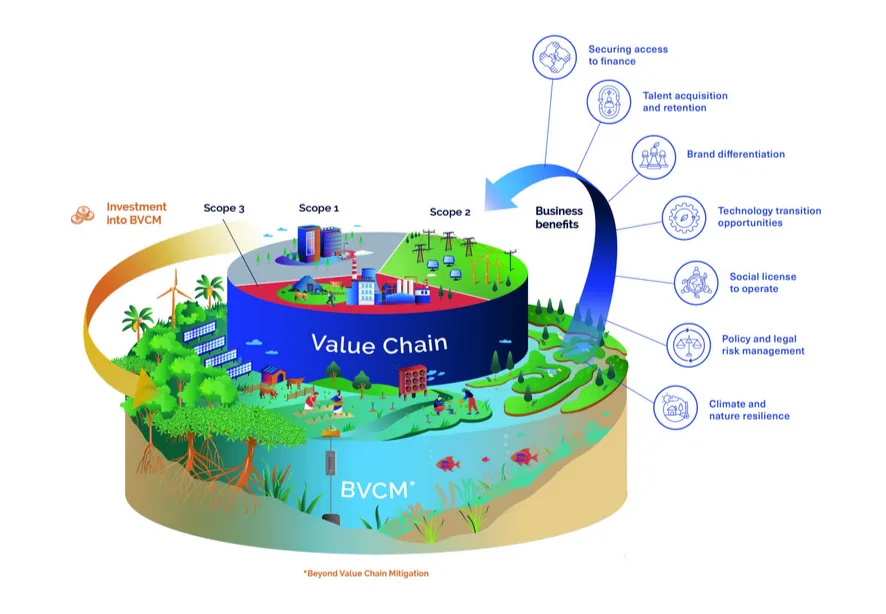
BVCM refers to all measures and investments aimed at reducing greenhouse gas emissions that occur outside a company’s own value chain. These include both mitigation and removal measures, such as financing reforestation projects, investing in carbon capture and storage (DACCS), or supporting climate protection programs in developing countries.
Unlike emissions reductions within a company’s own Scope 1–3 emissions, the BVCM represents a voluntary, additional commitment to global climate protection. Important: The BVCM does not replace the obligation to reduce emissions within a company’s own Science-Based Targets (SBTs), but rather complements them.
The current draft of the Net-Zero Standard Version 2.0 (March 2025) fundamentally changes the role of BVCM. Whereas BVCM was previously "merely" recommended, the new draft stipulates that companies must also implement BVCM measures as part of credible and comprehensive climate strategies , and that this will be explicitly recognized by the SBTi.
Companies that can demonstrate they are investing in climate protection measures outside their supply chain will gain greater visibility and credibility under the new standard.
To properly understand the role of Beyond Value Chain Mitigation (BVCM) within the context of a corporate climate strategy, it is essential to have a clear understanding of the terminology. The table below outlines the key concepts within the framework of net-zero strategies, as defined by the SBTi.
Abatement refers to all direct measures taken to prevent or reduce emissions within a company’s own value chain—in other words, the traditional “decarbonization” of Scope 1–3.
Neutralization only comes into play once the net-zero target has been achieved and refers to the offsetting of unavoidable residual emissions through permanent CO₂ removals.
Removals are physical measures for removing CO₂ from the atmosphere and form the basis for carbon neutralization strategies—they can take place within or outside the value chain.
BVCM goes beyond all of that: It encompasses voluntary measures that are not intended to offset a company’s own emissions, but rather aim to contribute to global emissions reduction—for example, through investments in climate protection projects, carbon removal, or nature-based solutions.
BVCM is gaining strategic importance as a result of the SBTi’s new draft standard. Companies seeking to develop a future-proof climate strategy should no longer treat BVCM as a voluntary afterthought, but rather systematically integrate it into their sustainability strategy. We recommend identifying suitable investment opportunities now and establishing credible impact chains.
Would you like to expand your climate strategy to include credible BVCM measures? Feel free to contact us—we can help you identify, assess, and communicate your climate impact beyond the value chain.

Best Practices
Governance & regulation

Governance & regulation
Best Practices

Experiences & comments
Best Practices


Contact us for all concerns and questions relating to sustainability. We are happy to make time for a personal meeting or a digital coffee.
Headquarters in Hamburg
Tel.: +49 174 1305766
Email: info@fiveglaciers.com
Branch Office in Kiel
Tel.: +49 (0) 174 1305766
Direct appointment booking


