













DATE
4.8.2025
AUTHORS
.webp)
Kevin Möller
TOPICS
Ratings & certifications
Best Practices
SHARE


Blog


DATE
4.8.2025
AUTHORS
Kevin Möller
TOPICS
Ratings & certifications
Best Practices
SHARE
Anyone going through an EcoVadis assessment for the first time knows the feeling: there’s a world of difference between a client’s request for a scorecard and your own sustainability management system. What looks like a simple “questionnaire” at first glance is actually a structured snapshot of your sustainability performance—and a gateway to new markets and customer relationships.
But how can you get started without getting bogged down in the details? This guide is designed for companies preparing for their first EcoVadis assessment and shows how you can approach the process pragmatically while also leveraging it strategically.
EcoVadis has long been more than just a supplier assessment tool. For many companies, the scorecard serves as the first systematic assessment of their current status: Where do we stand on environmental issues, human rights, ethics, and procurement—and how do we document this?
It is the initial assessment in particular that sets the course here:
This means that the first submission is not just a mandatory exercise for the client, but also a strategic reality check for the company’s own management.

The starting point is the account setup: You specify which entity is being evaluated, the size of your company, and the industry it belongs to. These details are not just a formality—they determine the entire evaluation framework. A manufacturing company with 1,000 employees will need to provide different documentation than a consulting firm with 50 employees.
If you do a thorough job here, you’ll avoid having to deal with customers or EcoVadis support later on.
Many companies initially view the questionnaire as a chore. In reality, it serves as a mirror of their own governance structure: What policies are in place? Which processes are documented? Where are training programs, audits, or KPIs implemented?
Especially when reading through it for the first time, it’s worth not jumping straight into filling it out, but rather viewing the questionnaire as a tool for taking stock: “Which questions can we answer—and where do we lack the basic information?”
The core of the assessment is not the text, but the documents. Policies, reports, and minutes are the basis on which EcoVadis verifies your claims.
This is where the wheat is separated from the chaff: A code of conduct without supporting evidence is ineffective, while a policy backed by training materials and key metrics scores points.
Best Practice: Create a document library organized by topic. Clear file names (“Anti-Corruption Policy_2024.pdf”) and a central repository make it much easier to reuse documents later on.
Submitting the answers is often the point at which time pressure increases. But the same rule applies here: it’s better to provide fewer answers that are precise. Each answer should be brief and clear, and each document should be clearly identified.
Our experience shows that companies that view the process as a collaborative effort involving multiple departments —HR, compliance, environmental management, and procurement—are not only faster but also more credible in their reporting.
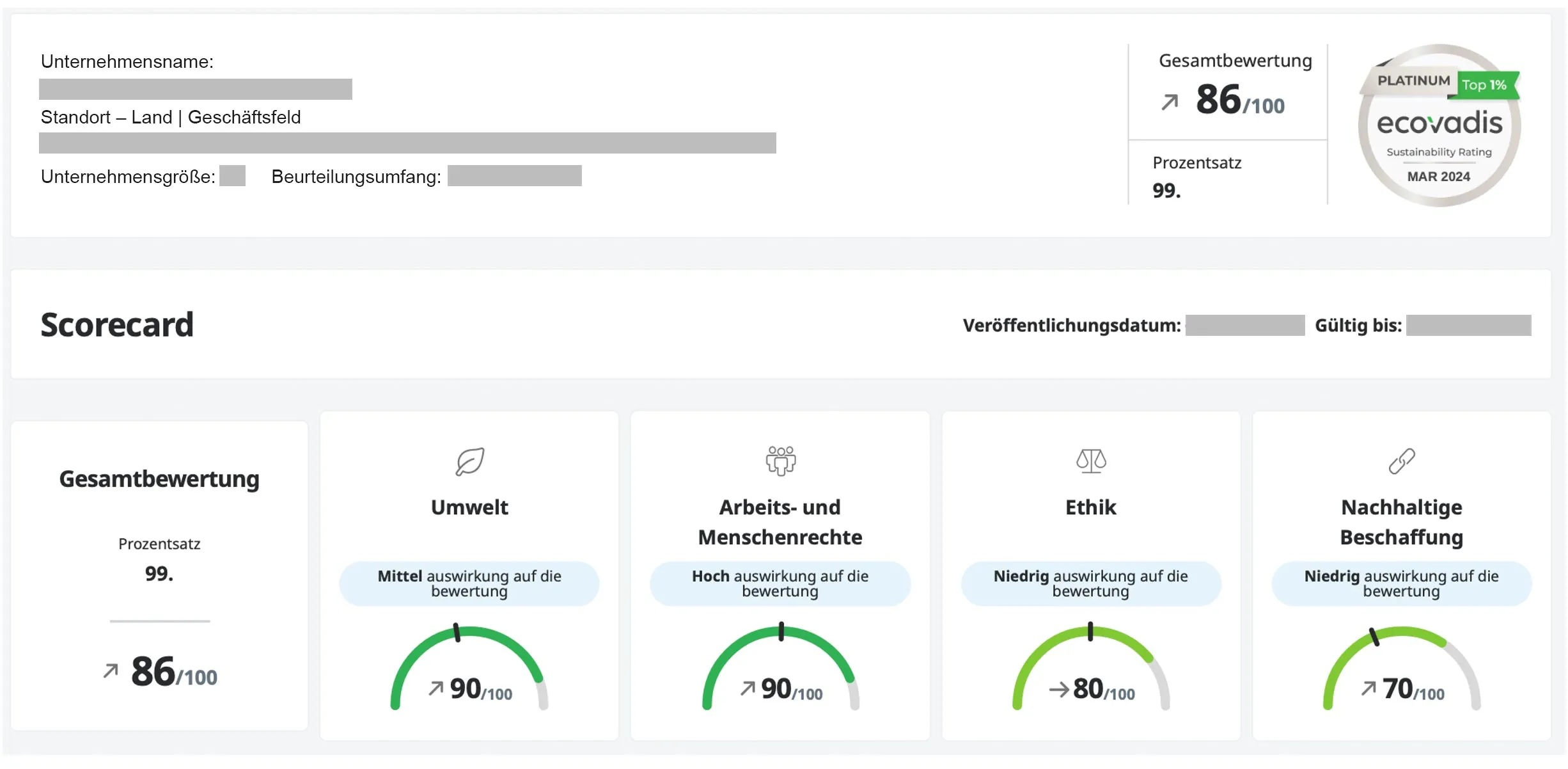
After 6–8 weeks, you’ll receive the results: a scorecard with points, a ranking (Bronze to Platinum), and a detailed analysis.
For first-time users, the temptation is strong to simply pass the results on to the client. In reality, this is where the greatest value lies: the scorecard serves as a roadmap for improvement. Those who view weaknesses not as criticism but as a call to action will not only achieve a better rating in the next cycle but also a measurably improved sustainability performance.
The first EcoVadis assessment is a learning process—for both small and large companies. Those who view it as an opportunity lay the groundwork for a professional ESG approach that extends far beyond the rating itself. With the right preparation, a clear documentation strategy, and cross-team collaboration, the first scorecard becomes not just proof for the client, but a strategic milestone.
Take advantage of quick wins, such as existing ISO certifications, audit reports, or ESG goals. These are literally "worth their weight in gold" for the initial assessment, and plan beyond the submission itself so that Ecovadis becomes a successful, annual initiative.
As an official EcoVadis Consulting Partner, Five Glaciers Consulting helps companies prepare for their initial assessment, organize their documents properly, and translate the results into a long-term sustainability strategy.
Q: How long does the preparation take?
A: Typically 4–8 weeks—depending on the documentation and our internal processes.
Q: Which language should I use?
A: In the DACH region, German is acceptable, but English is often preferable for international comparability.
Q: How long is the scorecard valid?
A: 12 months from the date of issue – after that, the next cycle begins.
Q: Does every document have to be perfect?
A: No, but it has to be official and reliable. It’s better to have a few strong pieces of evidence than many weak ones.


Ratings & certifications
Best Practices

Governance & regulation
Best Practices


Contact us for all concerns and questions relating to sustainability. We are happy to make time for a personal meeting or a digital coffee.
Headquarters in Hamburg
Tel.: +49 174 1305766
Email: info@fiveglaciers.com
Branch Office in Kiel
Tel.: +49 (0) 174 1305766
Direct appointment booking


