









DATE
25.7.2025
AUTHORS

Kevin Möller
TOPICS
Governance & regulation
Best Practices
Reporting
SHARE


 Climate managementUnternehmens-KlimabilanzProduktklimabilanzÖkobilanzierungClimate target settingTransition Plan (CTP)Bewerten von Klimarisiken
 ReportingReporting in accordance with CSRDWesentlichkeitsanalyse DWAVoluntary StandardEUDR-BeratungSECR-ReportingCBAM-Beratung
 StrategySustainability strategyManagement-SystemBiodiversity strategyClimate strategyClimate Transition PlanInterim-Team

Blog


DATE
25.7.2025
AUTHORS
Kevin Möller
TOPICS
Governance & regulation
Best Practices
Reporting
SHARE
On July 23, 2025, EFRAG published its highly anticipated “State of Play 2025” report—a data-driven snapshot of actual sustainability reporting by European companies in accordance with the European Sustainability Reporting Standards (ESRS) under the Corporate Sustainability Reporting Directive (CSRD). The report is based on 656 sustainability reports published between January 1 and April 20, 2025.
However, the report does not come out of nowhere: Implementation of the CSRD is not yet complete in some member states, and concrete relief measures were adopted in 2024 and 2025 through the European Commission’s “stop-the-clock” proposal and the “Omnibus II” package. These include, among other things, a reduced scope of reporting for companies in the first wave of implementation (Wave 1), for example through the option of deferred full disclosure or simplified requirements for certain disclosure obligations.
Nevertheless, the EFRAG report makes it clear that many companies are already reporting—in some cases well before formal national implementation. The report’s significance therefore lies in its role as an early indicator: it highlights the issues shaping the reality of ESRS implementation, identifies gaps, and outlines how companies—including those along the supply chain—should respond.
EFRAG (European Financial Reporting Advisory Group) is the European Commission’s main technical advisory body on financial and sustainability reporting. On behalf of the Commission, it develops the ESRS standards that companies will be required to apply under the CSRD in the future.
What EFRAG presents here is more than just a technical analysis. The report serves as an early indicator of reporting practices, market expectations, and emerging market realities. Although many of the companies analyzed are not yet subject to formal reporting requirements (e.g., because the CSRD has not yet been implemented at the national level), they are already publishing reports in accordance with ESRS.
This shows that these standards are, in fact, already having a significant impact on the market. In the future, anyone who is part of a large company’s supply chain will be held to these standards. After all, what is missing from large companies’ reports will increasingly be demanded of upstream stakeholders such as suppliers, service providers, or project partners.
So the key question is: Which issues are already classified as material today? And: How detailed, consistent, and in-depth are companies’ disclosures?
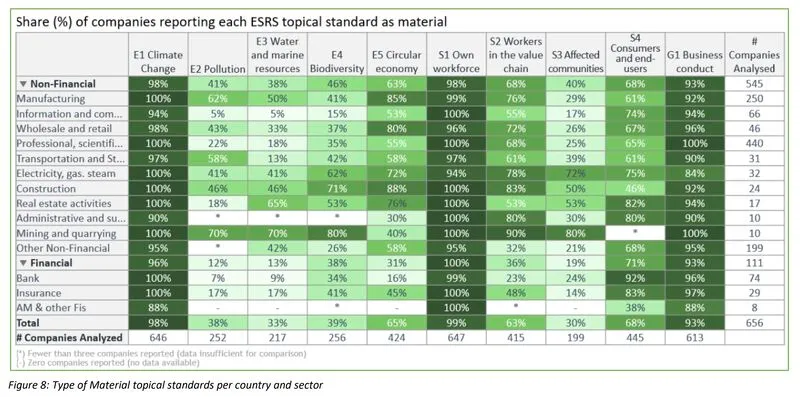
Only 10% of companies identified all ten thematic ESRS standards as material. Instead, three themes emerged as nearly universally material for both financial institutions and the real economy:
At the other end of the spectrum in the environmental sector are issues such as biodiversity, pollution, and water resources, which are rarely considered material outside of specific industries (e.g., chemicals, mining, food production).
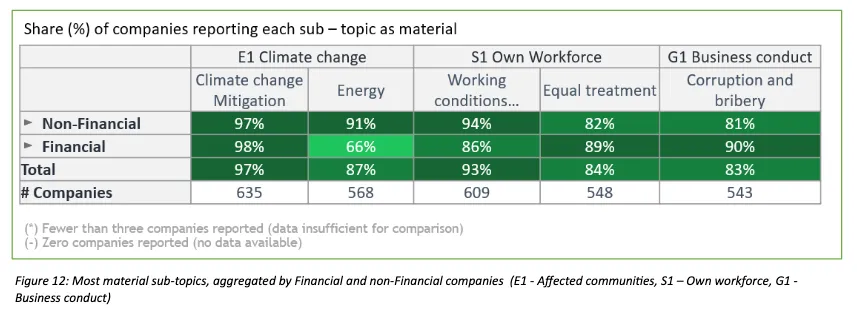
Clear trends in materiality are also evident at the sub-theme level: Five sub-themes are particularly frequently classified as material—including “climate protection,” “energy,” “working conditions,” “equal treatment,” and “corporate culture.” These themes are considered material by more than 80% of reporting companies. It is striking that non-financial companies in particular show significantly higher rates for almost all subtopics—for example, 97% for “climate protection” compared to only 66% for financial companies. This points to understandable differences in priorities depending on the type of company.
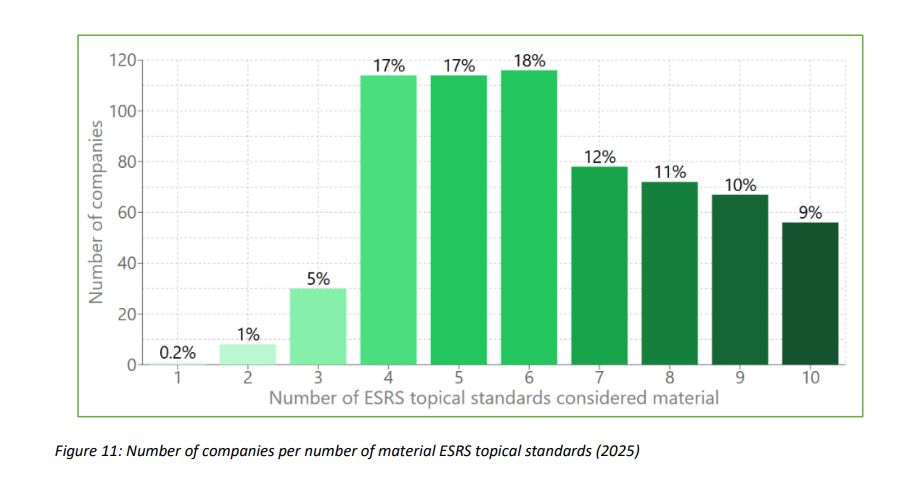
The EFRAG analysis also shows that companies approach materiality analysis in very different ways. Only about 10% of reporting companies classify all 10 thematic ESRS standards as material. The majority—more than half (52%)—select 4 to 6 material thematic standards. About a quarter report only 4 or fewer, although even in this group, standards E1, S1, and G1 were considered material. It therefore stands to reason that companies have actively and consciously used materiality analysis to set their own sustainability focus.
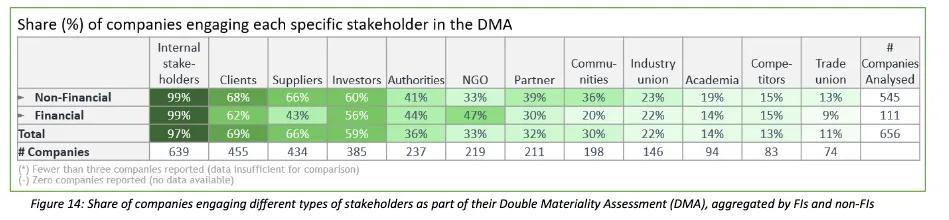
According to the report, 97% of companies involved internal stakeholders in their materiality analysis—particularly executives, functional departments, or ESG teams. The involvement of external societal groups (civil society, NGOs, affected communities), however, remains minimal.
This raises questions about the depth and legitimacy of the dual materiality approach, which is explicitly intended to address the outside-in perspective (impact on the environment and society).
About 55% of companies have published a climate transition plan—a key component of the ESRS-E1 standard. However, the quality and depth of these plans vary significantly. While some companies present fact-based roadmaps with capital expenditure allocations, interim targets, and dependencies, others limit themselves to strategic statements of intent lacking measurable content.
Another finding: While approximately 70% of companies are aiming for emissions targets aligned with the 1.5°C goal (Scope 1 & 2), only 40% of these targets also include Scope 3 emissions. And even though 60% of companies have had their targets validated by the SBTi, transparency regarding Scope 3 remains a challenge.
The high number of reported 1.5°C-compatible climate transformation plans in the 2023 CDP Rating—approximately 5,900 companies, or 26% of respondents—confirms the upward trend that CDP highlights once again in 2024. This increase underscores that strategic climate plans are increasingly perceived as a central component of credible sustainability reporting.
A closer look at the report’s detailed analyses reveals that, despite their social and regulatory significance, certain topics have so far been disclosed only to a limited extent:
For companies that are not currently subject to the CSRD, this report is nonetheless highly relevant. This is because what large companies subject to reporting requirements (must) disclose in their sustainability statements will, in the future, be “factored into prices” retroactively along the value chain:
In addition, the report offers practical guidance for developing your own understanding of materiality:
The new voluntary SME standard, VSME (Voluntary Sustainability Reporting Standard for Micro-Enterprises), which EFRAG is developing in parallel, offers a complementary approach. This modular system enables small and medium-sized enterprises to produce structured, streamlined, and practical reports—thereby allowing them to anticipate the key requirements of major business partners at an early stage.
The “State of Play” analysis clearly demonstrates that sustainability reporting has long been evolving not only in response to regulatory requirements but also in line with market dynamics. Even without a formal CSRD obligation, many companies are already publishing reports in accordance with the ESRS—because it is expected, required, or strategically sound.
For companies not subject to reporting requirements, this means: Now is the time to proactively assess relevance and materiality, initiate internal data processes, and address the expectations of their stakeholders—whether investors, major customers, or employees.
The report provides a valuable foundation for this. Anyone who reads it carefully will recognize not only what is formally required, but also what will be strategically necessary.

Experiences & comments
Best Practices

Governance & regulation

Reporting
Governance & regulation


Contact us for all concerns and questions relating to sustainability. We are happy to make time for a personal meeting or a digital coffee.
Headquarters in Hamburg
Tel.: +49 174 1305766
Email: info@fiveglaciers.com
Branch Office in Kiel
Tel.: +49 (0) 174 1305766
Direct appointment booking


